Friday, July 26, 2013

Dogs with long and low body types at much higher risk for slipped discs

Dogs with long and low body types at much higher risk for slipped discs

Researchers at The Royal Veterinary College recently published the results of their study to examine the correlation between dog body shape and the occurrence of slipped discs.

After examining 700 dogs - 79 of which developed slipped discs in their backs - the researchers were able to determine that having a longer and lower body shape dramatically increased dogs' risk of slipped discs, they reported in the journal PLOS ONE.

Other risk-increasing factors included obesity and small body size, although a few breeds (Jack Russell terriers and cocker spaniels) had a higher risk even though they don't have long and low body types, the college said on its website.

Breeding "dwarf" dogs puts their health at risk
Dwarf breeds such as dachshunds and basset hounds are bred to have long bodies and shorter legs, and the unusual cartilage in their spines tends to degenerate and harden more quickly than in dogs with non-dwarf body types. This combination of physical traits often leads to spinal injuries, and the effects are amplified even further when the dogs are small in size, researchers said.

One extreme example of this phenomenon lies in the body proportions of very long miniature dachshunds, who have backs that are two-thirds longer than their shoulder height. According to the study, these extra-long dogs are twice as likely as the shortest individuals of the same breed to slip a disc by the age of five.

Dr. Charlotte Burn, who led the study, pointed out that smaller dogs with long bodies are more likely to be injured because their bodies are ill-equipped for demanding physical tasks such as jumping down steps or into cars.

Weight problems add to the problem, researchers said, as obese dogs had triple the risk of slipped discs. They added that low-risk breeds still had a low risk of spinal injury if they were obese, but obese dogs in the high-risk breed categories were much more susceptible to slipped discs.

Rowena Parker, a researcher from the college who conducted the study, said veterinarians need to work with breeders to spare future generations of dogs from painful spinal problems that sometimes even lead to euthanasia.

"We regularly see some of the longest dogs come into the hospital for their first, second, or even third slipped disc," Parker said. "Unfortunately, this disorder is so common in some of the longest breeds, that it could almost be regarded as 'normal,' however breeders and vets should not become desensitized to this serious condition, and must work together to reduce its occurrence as it causes huge distress for both the dog and owner."

Thursday, July 25, 2013

Homemade dog food recipes can be risky business, study finds

Be cautious with home-made diets. From the AVMA Animal Health SmartBrief

Homemade dog food recipes can be risky business, study finds

Jul 24, 2013
When it comes to canine cuisine, home cooking may not be all it's cracked up to be, reports a team of researchers at the University of California, Davis, School of Veterinary Medicine.

In what is thought to be the largest ever nutritional evaluation of recipes for home-prepared dog foods, the researchers found that very few of 200 recipes analyzed provided all of the essential nutrients in amounts adequate for meeting established canine health standards.

Findings from the study appear in the June issue of the Journal of the American Veterinary Medical Association.

"Some owners prefer to prepare their dogs' food at home because they feel they have better control over the animals' diet, want to provide a more natural food or simply don't trust pet food companies," said Jennifer Larsen, an assistant professor of clinical nutrition at the William R. Pritchard Veterinary Medical Teaching Hospital at UC Davis and lead author on the study.

"The results of this study, however, indicate that most available recipes for healthy dogs, even those published in books by veterinarians, do not provide essential nutrients in the quantities required by the dog," Larsen said. "It is extremely difficult for the average pet owner—or even veterinarians—to come up with balanced recipes to create appropriate meals that are safe for long-term use," she said.

"Homemade food is a great option for many pets, but we recommend that owners avoid general recipes from books and the Internet and instead consult with a board-certified veterinary nutritionist," Larsen said. "These specialists have advanced training in nutrition to help formulate customized and nutritionally appropriate recipes."

Larsen, together with Jonathan Stockman, a veterinarian and second-year resident in at UC Davis, selected 200 recipes from 34 different sources, including veterinary textbooks, pet care books and web sites. They evaluated both the ingredients and the instructions for each recipe, using a computer-based program to quantify the nutritional content of the food described by each recipe, as well as the specificity of the instructions.

They found that only nine of the 200 recipes —including eight of the nine written by veterinarians—provided all essential nutrients in concentrations that met the minimum standards established for adult dogs by the Association of American Feed Control Officials, while only five recipes—all written by veterinarians—provided in concentrations that met the National Research Council's Minimum Requirements for adult dogs.

Although recipes written by veterinarians were less likely to have any nutrient deficiencies—and those being less severe—most still had at least one deficiency. Interestingly, only four of the 200 recipes were written by board-certified veterinary nutritionists, and all of those four recipes had acceptable nutrient profiles for adult dogs.

Overall, 95 percent of the 200 recipes examined resulted in food that was lacking in the necessary levels of at least one essential nutrient, and more than 83 percent of the recipes had multiple nutrient deficiencies.
"Some of the deficiencies, particularly those related to choline, vitamin D, zinc and vitamin E, could result in significant health problems such as immune dysfunction, accumulation of fat in the liver and musculoskeletal abnormalities," Larsen said.

"Also, since so many recipes shared the same deficiencies, rotation of recipes and the feeding of different foods to achieve variety—known as the 'balance over time concept'—is not likely to correct these problems," she said.

The researchers also found that 92 percent of the recipes contained vague or incomplete instructions that required the pet owner to make at least one assumption related to the ingredients, method of preparation or the use of supplement-type products. Furthermore, 85 percent of the recipes did not provide calorie information for the recipe or advise for what size of pet the recipe was intended.

In order to corroborate the results of the computer-based analysis, the researchers also conducted laboratory analysis of nutrient content for the dog food that was prepared according to the instructions specified by 15 of the 200 recipes. The 15 recipes were selected to represent a variety of sources including books and websites, and a variety of ingredients.

In comparing the results from the laboratory analysis with the computer-based analysis for these 15 recipes, the researchers found that both assessment methods agreed on deficiencies and excesses, with only a few discrepancies.

"The data support the concept that computer-based analysis is a reliable method for detecting inadequacies in recipes for homemade dog food," Larsen said.

Other UC Davis researchers collaborating on this study were Professor Andrea Fascetti, chief of the nutrition service at the William R. Pritchard Veterinary Medical Teaching Hospital, and Professor Philip Kass, a veterinary epidemiologist.

The study was supported by the Center for Companion Animal Health at the UC Davis School of Veterinary Medicine. Larsen is a co-owner of DVM Consulting Inc., which licenses the software used to analyze the .

Cat allergy discovery promises new treatments

From the AVMA Animal Health SmartBrief.

Cat allergy discovery promises new treatments


New research led by the University of Cambridge in the UK has discovered the reason for the extreme immune reaction in some people who are allergic to cats. A study published online this week in the Journal of Immunology explains how the cat allergen Fel d 1 triggers an immune receptor that is also involved in allergic responses to dust mites. 
 
Lead author Dr. Clare Bryant, from Cambridge's Department of Veterinary Medicine, told the press:
"We are hopeful that our research will lead to new and improved treatments for cat and possibly dog allergy sufferers."

The idea is that new drugs could target the pathway to the newly discovered receptor so it can't trigger the severe immune response in affected people.

Until this study, scientists were somewhat mystified by the severe reaction of the immune system to cat allergen.

They already knew that the most common culprit was the cat allergen Fel d 1, which is present in cat dander, the microscopic pieces of cat skin that are often accompanied by saliva from grooming and become airborne, landing on furnishings, bedding, carpets, curtains and many other surfaces and objects in the home.

Allergic reactions are the result of the immune system responding to what it perceives as dangers or threats to health and life. Normally these threats are from pathogens like viruses and bacteria. Part of the mechanism of recognizing and reacting to pathogens are proteins called receptors, which behave like unique locks, which can only be released when the correct key comes along.

But sometimes the immune system misidentifies a non-threatening substance, reacts to it as if it were a pathogen and mounts the same inflammatory response. One way this happens is because a "key" that shouldn't release a lock somehow does so. In the case of Fel d 1, the lock that it releases or triggers is the pathogen recognition receptor Toll-like receptor 4 (TLR4).

TLR4 is already known to be involved in allergic reactions to dust mites and the metal nickel.

But Bryant and colleagues discovered that Fel d 1 is aided and abetted by another culprit. It teams up with a bacterial toxin found everywhere in the environment. It only needs very low doses of this toxin, called lipopolysaccharide (LPS) to unleash the severe immune response seen in people with cat allergy.

For their study, the team ran a set of tests where they exposed human cells to cat and dog dander proteins. In some tests they added low levels of LPS, and in the others they did not.

They discovered that the presence of the bacterial toxin LPS somehow increases the signalling to the immune system, intensifying the response to the cat allergen Fel d 1.

In a further set of tests, they then discovered TLR4 was the part of the immune system that was reacting to the combination of LPS and Fel d 1.

And when they used a drug that blocks TLR4 (essentially by occupying the lock so the allergen "key" can't get in to release it), they found the cat dander protein had no effect on human cells: they had prevented the inflammatory immune response. Bryant says:
"Not only did we find out that LPS exacerbates the immune response's reaction to cat dander, we identified the part of immune system that recognises it, the receptor TLR4."
The team also found that the allergen Can f 6, which is present in dog dander, also activates TLR4 when LPS is present.

Drugs to inhibit TLR4 are already available, says Bryant, so they are hopeful that their "research will lead to new and improved treatments for cat and possibly dog allergy sufferers."

Funds from the Wellcome Trust and the Medical Research Council (MRC) helped finance the study.
Written by Catharine Paddock PhD
Copyright: Medical News Today

Monday, July 22, 2013

Traveling with Your Pet

Traveling with Your Pet

Useful information from the AVMA.

Q: What should I think about when deciding to travel with my pet?
A: There are numerous considerations you should take into account:
  • Make sure your pet is comfortable with travel
    • Some pets cannot handle travel because of illness, injury, age or temperament.
    • If your pet is not good with travel, you should consider a reliable pet-sitter or talk to your veterinarian about boarding facilities in your area.
  • Make sure your pet has identification tags with up-to-date information.
  • Having your pet implanted with a microchip can improve your chances of getting your pet back if it becomes lost. The microchip must be registered with your current contact information, including a cell phone number. A tag is included when you have a microchip that has the microchip number and a mobile contact of the owner, so if the pet is found, they can use the tag to determine ownership without having to contact a veterinarian. Contact the microchip company for a replacement tag if you've lost yours, and for information on how to update your personal information when traveling.
  • If you are taking your pet across state or international borders, a health certificate is required. The health certificate must be signed by a veterinarian after your pet has been examined and found to be free of disease. Your pet's vaccinations must be up to date in order for the health certificate to be completed.
  • Make sure that your pet is allowed where you are staying. Some accommodations will allow pets and some will not, so check in advance. Also, when traveling, you should bring a portable kennel with you if you have to leave your pet unattended.
    • Staying with Friends or Family: Inform your host that your pet will be coming along and make sure that your pet is a welcomed guest as well.
    • Staying in a Hotel or Motel: Stay at a pet friendly place. Some hotels and motels only accept small pets or pets under a certain weight; when making a reservation, make sure you inquire about the terms of their pet policy. Try to minimize the amount of time your pet will be alone in the room. When leaving your pet alone in the room, inform the front desk that your pet is being left alone in the room and place a "Do Not Disturb" sign on the door. Make sure the hotel/motel knows how they can contact you if there are any problems.
    • Staying at a Park, Campground or Marina: Make sure these places are pet friendly, clean up after your pet and always keep your pet on a leash.
Q: Whom should I contact as I am considering travel arrangements?
A: All of the following are important:
  • Your veterinarian
  • The airline or travel company
  • The accommodations: hotel, motel, park, camping ground or marina
  • The U.S. Department of Agriculture, Animal & Plant Inspection Service, Veterinary Services: www.aphis.usda.gov/vs/sregs or 800-545-USDA (8732) and press #2 for State Regulations
  • Foreign Consulate or Regulatory Agency (if traveling to another country)
    • If you are traveling to another country (or even Hawaii), there may be quarantine or other health requirements
    • If traveling out of the continental United States, you should contact these agencies at least 4 weeks in advance

Q: What should I bring with me on my trip?
A: You should bring the following items with you:
  • Your veterinarian's contact information
  • List of Veterinarians and 24 hour Emergency Hospitals along the way and close to your destination
    To find a listing of Veterinarians & Pet Emergency Hospitals in the United States, contact:
  • National Animal Poison Control(ASPCA Web site)
    888-426-4435
  • Identification
    • Current color photo of your pet
    • ID tag should include:
      • Owner's name, current home address and home phone number
    • Travel ID tag should include:
      • Owner's local contact phone number and address
      • Contact information for your accommodations (hotel, campground etc)
    • The microchip registration should be updated with your current contact information including a cell phone number.
  • Medical Records
    • Current copies of your pet's medical records including pre-existing conditions and medications (especially when re-locating or traveling out of the country). For travel within the United States, a brief summary of medical conditions would be sufficient.
  • Certificate of Veterinary Inspection (health certificate)
    • Proof of vaccinations (Proof of rabies vaccination required) and other illnesses
    • Requires an examination by a licensed and accredited veterinarian to make sure the animal is not showing signs of disease.
  • Acclimation certificate for air travel
    • This is only required by some airlines, so check to see if your airline requires this.
  • Items for your pet
    • Prescribed medications (adequate supply for entire duration of trip and several days' surplus supply, just in case)
    • Collar, leash, harness
    • Crate
    • Bed/blankets
    • Toys
    • Food and cool, fresh water
    • Food and water dishes
  • First Aid Kit for your pet
    *For more information on Pet First Aid and First Aid Kits, please go to the AVMA Pet First Aid Site
Q: Where do I get a Certificate of Veterinary Inspection (health certificate) and acclimation certificate, if needed?
A: Many states require an up-to-date Certificate of Veterinary Inspection from a licensed, accredited veterinarian when traveling. Your pet must be examined by a veterinarian in order for a health certificate to be issued. This certificate basically indicates your pet is healthy to travel and is not showing signs of a disease that could be passed to other animals or to people. Certain vaccinations must be up to date for a health certificate to be issued. As part of the exam, your veterinarian may check for heartworm disease and prescribe heartworm preventative medication. When you return home, your veterinarian may recommend a follow-up examination to make sure that your pet did not pick up any diseases or parasites while traveling.
You will need a Certificate of Veterinary Inspection to travel and some airlines require an acclimation certificate. Both of these certificates can only be completed and signed by a federally accredited veterinarian. If your veterinarian is not federally accredited, you will need to find an accredited veterinarian in your area, by contacting your USDA Area Office.
View our video about travel certificates for pets and livestock.

Q: Can I bring my pet out of the country with me?
A: Yes, but keep in mind that you have to follow both the United States regulations as well as the regulations in the other country to which you are traveling.
You should contact the Consulate or Embassy in that country to find out their regulations. Talk to your veterinarian about the risks of disease to your pet and have your pet vaccinated appropriately based on the risks. Some countries (and Hawaii) require quarantine of your pet upon arrival, Knowing the requirements before you travel helps you decide if you are going to take your pet or leave it at home, and prepares you for what to expect if you do take your pet with you.

Q: Can I bring my pet camping?
A: Yes. The same rules apply when taking your pet camping. Talk to your veterinarian about flea, tick and heartworm prevention as well as specific risks associated with camping outdoors. (such as leptospirosis and other diseases).
Keep your pet on a leash and in your sight; and be considerate of other campers. Clean up after your pet.
Being outside, your pet can be exposed to many different wild animals like skunks, raccoons, snakes and other animals that can injure your pet or expose them to disease. Do not let your pet chase or come into contact with wildlife—it can be dangerous for both your pet and the wild animal.
View our information for outdoor enthusiasts.

Forms of travel

Traveling by Plane | Traveling by Boat | Traveling by Car | Traveling by Train or Bus

Traveling by Plane

Q: What can I do to prepare my pet for air travel?
A: The following preparations will help both you and your pet:
  • Check with airlines because they may have restrictions on breed and size.
  • Most airlines also require a Certificate of Veterinary Inspection (health certificate) issued within 10 days of travel.
  • Federal regulations require pets to be at least 8 weeks old and they should be weaned at least 5 days before flying.
  • Talk to your veterinarian about feeding schedules. It is usually recommended that pets fly on an empty or nearly empty stomach. The pet's age, dietary needs and size, and the time and distance of the flight should all be taken into consideration.
Q: What is the best way to choose flights appropriate for my pet?
A: The following will help you choose flights that are appropriate:
  • Reservations should be made for you and your pet at the same time because airlines often limit how many pets are allowed on each flight.
  • Try to book a non-stop flight and avoid plane changes when possible.
  • When possible, avoid flying during busy holidays.
  • In warm weather, choose early morning or late evening flights.
  • In colder weather, choose mid-day flights.
  • Reconfirm flight arrangements the day before you leave to minimize the chance of unexpected changes.
Q: What should I do on the day of the flight?
A: On the day of your flight:
  • Arrive to the airport early so you have time to exercise your pet.
  • If your pet will be in the cabin, check in as late as possible to reduce the time your pet will have to wait in the terminal.
  • Place your pet in its crate and pick it up as soon as you arrive at your destination.
  • Notify the flight attendant that your pet is in cargo hold.
Q: What is an acclimation certificate?
A: This is a form from your veterinarian that will waive the low temperature Federal regulation as stated in the Animal Welfare Act.
  • If the airline cannot guarantee that the animal will not be in temperatures lower than 45°F (7.2°C) for more than 45 minutes when the animal is moved between the terminal and the plane, or for more than 4 hours when the pet is in a holding facility, and you don't have an acclimation certificate, the airline will not let your pet fly.
  • Airlines cannot ship animals if temperatures will be higher than 85° F (29.5 C) for more than four consecutive hours while in animal holding areas of airport terminals or for more than 45 minutes while transferring the animal between the aircraft and the animal holding area, under any circumstances.
Q: Do I need to get an acclimation certificate?
A: Some airlines will require an acclimation certificate in order to let your pet travel.
  • Acclimation certificates are written at the discretion of the veterinarian, and are based on the veterinarian's assessment of the pet's health.
  • There are no acclimation certificates that allow pets to be shipped when conditions are above 85°F (29.5°C).
Q: Should I tranquilize or sedate my pet for long flights?
A: It is recommended that you DO NOT give tranquilizers to your pet when traveling by air because it can increase the risk of heart and respiratory problems. Short-nosed dogs and cats sometimes have even more difficulty with travel. Visit our FAQs about short-nosed dogs and air travel for more information.
Airlines may require a signed statement that your pet has not been tranquilized prior to flying.
According to Dr. Patricia Olsen with the American Humane Association, "An animal's natural ability to balance and maintain equilibrium is altered under sedation and when the kennel is moved, a sedated animal may not be able to brace and prevent injury."

Q: What are crates approved for air travel?
A: It is best to purchase an approved crate prior to travel (at the airline or local pet store) so you have time to let your pet get used to the crate and be comfortable. If your pet is small and can fit comfortably in an airline approved carrier, your pet may be able to travel with you in the cabin.
Approved crates should:
  • Be large enough for your pet to stand (without touching the top of the cage), turn around and lie down
  • Be strong and free of interior protrusions, with handles or grips
  • Have a leak-proof bottom with plenty of absorbent material
  • Be ventilated on opposite sides, with exterior knobs and rims that will not block airflow
  • Be clearly labeled with owners name, home address and phone number, destination contact information and a sign stating "Live Animals" with arrows showing which way is upright

Traveling by Boat

Q: How do I prepare my pet for traveling in my boat?
A: For personal boats, take time to allow your pet to become familiar with your boat.
  • Provide a ramp for your pet to easily get on and off the boat, or carry your pet on and off the boat.
  • Call ahead to make sure the marina or park is pet friendly.
Q: What items should I bring with me to keep my pet safe?
A: Bring the following items:
  • Your pet should wear a proper-fitting personal flotation device (a life jacket) at all times to keep your pet safe in and around water, even if they know how to swim.
  • Applying sunscreen prevents sunburn to your pet, especially pets with light skin and short or thin haircoats. Ask your veterinarian to recommend a non-toxic, non-skin irritating sunscreen for your pets.
  • Provide non-slip bathroom rugs to assist your pet from sliding on the wet boat and from burning their paws.
  • You should have your pet in a carrier, or on a harness or leash to prevent them from jumping or falling overboard.
Q: How will my pet go to the bathroom when on a boat?
A: You can train your dog to use a piece of astroturf, a box of sod or newspaper. For cats and other small animals that use litter boxes, make sure there is a covered litterbox secured to the floor inside the boat.

Q: What should I do to prepare when traveling on a cruise with my pet?
A: To prepare for traveling with your pet on a cruise:
  • For public boats, check with the boating company to find out their requirements and restrictions.
  • Most boating companies will require you to provide a regulation carrier and a leash for dogs.
  • You will also need a Certificate of Veterinary Inspection (health certificate) and possibly a travel form, depending on the areas that you will be visiting.
Q: What are some other things to think about when traveling by boat?
A: Here are some other things you should think about:
  • When traveling by boat, your pet should have exercise before boarding and when you make stops.
  • When traveling to foreign countries, you will need an International Certificate of Veterinary Inspection (health certificate).
  • You may also need a permit and have to fill out a form. Information about pet passports to foreign countries can be found at Pet Travel
  • Some pets get motion sicknesses on boats. If your pet becomes motion sick in the car, it will likely be sick on a boat. Talk to your veterinarian about alternate traveling suggestions or medications.

Traveling by Car


Q: What can I do to prepare my pet for traveling in a car?
A: If your pet does not ride well in a car, consider leaving your pet at home, with friends or family, or in a boarding facility.
  • If you don't often take your pet in the car, start with short trips to "fun" destinations (such as a dog-friendly park or play area) to help your pet get used to riding in a car.
  • If your pet gets car sick, talk to your veterinarian about alternate traveling suggestions or medications to keep them comfortable.
Q: What should I do to keep my pet safe and healthy?
A: To keep your pet safe and healthy:
  • Make frequent stops (about every 2-3 hours) to allow your pet to go to the bathroom and get some exercise.
  • Properly restrain your pet in the car to prevent injury to your pets, you and to other drivers.
  • Do not let your pet ride in the back of a truck. If your pet must ride in the truck bed, they should be confined in a protective kennel that is secured to the truck to prevent injury.
    » View the AVMA Policy
    » View the AVMA Backgrounder
  • Pets should not be allowed to ride with their heads outside the window. Dirt and other debris can enter their eyes, ears and nose and cause injury or infection.
  • Pets should not be allowed to ride on the driver's lap or near the driver's feet. Small pets should be confined in crates or in travel-safe dog beds, and larger pets should be appropriately restrained with harnesses attached to the car's seat belts.
  • Cats should be transported in carriers.
  • Providing a familiar blanket and/or safe toy can help make your pet more comfortable during the trip.
  • Pets in Cars
  • Pets in Vehicles

Traveling by Train or Bus

Q: Can my pet travel with me on a train or bus?
A: Most states restrict the travel of pets on trains or buses. Exceptions are made for guide or service dogs. Check with your carrier to find out if your pet can come with you and what rules and regulations apply.

Other resources

For Pet Owners:

Sunday, July 21, 2013

Company's Hypoallergenic Cat Breed Claims May be a Scam

From AOL......

Many cat lovers with cat allergies would be willing to pay top dollar for a truly hypoallergenic cat, so when a biotech company called Allerca announced in 2006 that it had developed such a breed, prospective owners forked over thousands or even tens of thousands of dollars to get one. But now an investigative report by ABC's "The Lookout" has shown that Allerca's claims about hypoallergenic cats appear to be a lot of unsubstantiated hype.

A protein known as Fel d 1, found in cats' saliva, is what causes allergies to cats. Simon Brodie, the founder of Allerca (now known as Lifestyle Pets) claims that the cats he developed still produce Fel d 1, but at a different molecular weight that does not trigger allergies. However, customers who bought Allerca's cats say that claim is false, that they still suffered from their allergies. Some owners have even been forced to give away their expensive Allerca cats because their allergies to the cats were so bad.

"The Lookout" gave hair samples from Allerca cats to Indoor Biotechnologies, an immunodiagnostics and biotechnology company specializing in allergy, asthma and indoor air quality. The company's tests showed no detectable differences in the Fel d 1 from Allerca cats, concluding that they were no more hypoallergenic than any other everyday house cat.

The investigative team from "The Lookout" confronted Brodie with their findings. Brodie defended his company, saying he has sold hundreds of cats to satisfied customers. He also provided a DNA report to back up his claims. However, "The Lookout" brought that report and other tests displayed on the Allerca website to the scientists who ran the tests, and the scientists claimed that the test results did not actually support Brodie's claims that his cats are hypoallergenic.

Given the dubiousness of Allerca's claims, potential customers will need to decide for themselves whether it's worth spending the money on one of the company's supposedly hypoallergenic cats.

Thursday, July 18, 2013

Retail dog, cat, rabbit sales banned in San Diego

Retail dog, cat, rabbit sales banned in San Diego
Amendment passes unanimously in an effort to thwart 'puppy mill' pet shop suppliers.

DVM360 MAGAZINE

The San Diego, Calif., City Council voted unanimously to ban the retail sale of dogs, cats and rabbits in pet stores July 9. The bill was proposed by Councilwoman Lorie Zapf to prevent “puppy mills” from supplying to pet stores. The new law should take effect in about 30 days after a second reading by the council.

The amendment to the municipal code makes it “unlawful for any person to display, offer for sale, deliver, barter, auction, give away, transfer or sell any live dog, cat or rabbit in any pet shop, retail business or other commercial establishment located in the city of San Diego, unless the dog, cat or rabbit was obtained from a city or county animal shelter or animal control agency, a humane society or a nonprofit rescue organization.’’

The amendment will require pet stores to keep certificates that name the source of their animal inventory in order to make the information available to animal control officers, law enforcement, code compliance officials or other city employees. Pet stores may still contract with animal shelters, animal control agencies, humane societies or nonprofit organizations to sell dogs, cats and rabbits to consumers.

Several other California cities have adopted a similar ban. San Diego will be the second largest city in the nation with retail ban—Los Angeles is the largest.

Friday, July 12, 2013

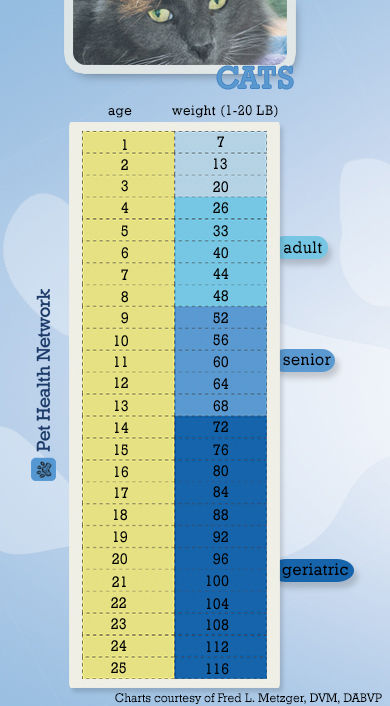
How Old Is Your Cat in People Years?


How old is your cat in people years?

The health of your pet can change drastically as he or she ages

Posted December 11, 2012 in Cat Health
cat age
Share This Story

28

694
836
Beginning at around age 9, your cat enters his or her senior years. At this stage, pets often begin to develop diseases common to their senior human counterparts, such as diabetes, heart disease, hyperthyroidism, and cancer. In fact, one out of 10 pets that appears healthy has an underlying disease.1  
First, identify your cat's real age using this chart. Then, discuss ways to keep your pet healthy with your veterinarian.

Reference:
1. Rehm M. Seeing double.Veterinary Economics. 2007;48(10):40-48.
- See more at: http://www.pethealthnetwork.com/cat-health/how-old-your-cat-people-years#sthash.L58qGBbW.dpuf