Wednesday, August 15, 2012

Owners of Aggressive Dog Breeds Are More Hostile

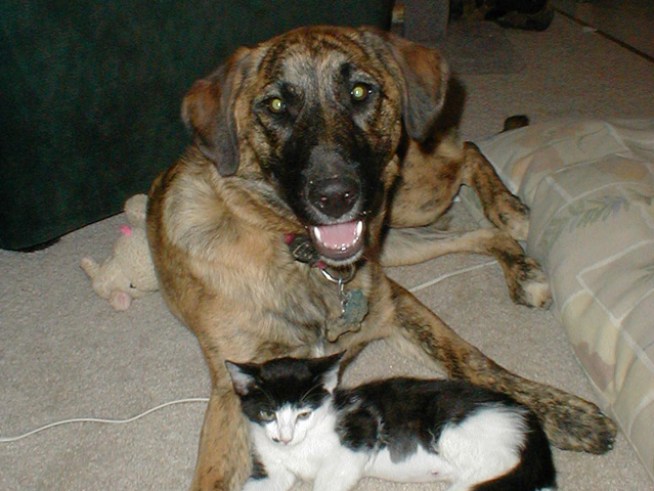
Hmmmm.....so what does this make me as we have a Great Dane, two German Shepherds, a chihuahua, and a chihuahua-rat terrier mix. I must have a conflicted personality!

This is from the AVMA Animal Health SmartBrief

Owners of Aggressive Dog Breeds Are More Hostile

Date: 09 August 2012 Time: 02:46 PM ET


Rottweiler dog outside
Owners of stereotypically aggressive dog breeds such as Rottweilers have more aggressive personalities themselves, a new study finds -- though this does not mean that they or their dogs are necessarily dangerous.

Your canine companion might be saying more about you than you realize, new research finds.

Owners of stereotypically aggressive dog breeds such as German shepherds and Rottweilers are more likely to be hostile and aggressive themselves compared with owners of typically laid-back pooches such as Labrador retrievers, according to a new study.

In this study, aggressive dog-breed owners scored higher in the personality trait of psychoticism, which is marked by anger, hostility and aggression. (Psychoticism is different than psychopathy, a personality disorder characterized by manipulativeness and lack of empathy.)

"This might imply (although has yet to be proven) that people choose pets that are an extension of themselves," study researcher Deborah Wells, a psychologist at Queen's University Belfast, told LiveScience in an email.

Dogs and personality
The research, published in the October 2012 issue of the journal Personality and Individual Differences, is not the first to find personality differences in dog owners based on breed. Toy-dog owners, for example, score high on the personality trait of openness, characterized by appreciation of new experiences, according to a study presented at the British Psychological Society annual conference in London in April. The same study found that owners of pastoral and utility breeds such as collies and corgis were the most extroverted. [See What Your Dog's Breed Says About You]

Likewise, a study published in May in the journal Anthrozoos found that people with more argumentative personalities are more likely to choose bull terriers or other breeds with a reputation for aggression than more agreeable types.

Aggressive owners, aggressive breeds
Wells and her colleague Peter Hepper, also of Queen's University Belfast, recruited 147 dog owners from obedience classes in Northern Ireland and asked them to fill out a personality questionnaire. Only owners of German shepherds, Rottweilers, Labrador retrievers and golden retrievers were included in the questionnaire.

"We deliberately wanted to focus on breeds that are commonly owned, but at opposite ends of the spectrum in terms of public perception of temperament — both Germans shepherds and Rottweilers are commonly perceived to be aggressive, while labs and retrievers (breeds frequently used to advertise organizations such as Guide Dogs for the Blind) are more likely to regarded in a nonaggressive light," Wells said.

Through centuries of breeding, humans have created dogs as tiny as the Chihuahua and as big and broad-chested as the English Mastiff. 
Of the personality traits studied, the only difference between breed types that emerged was in psychoticism, such that owners of stereotypically aggressive breeds were more aggressive themselves than owners of more relaxed dogs.

The study still leaves open the question of whether aggressive people choose aggressive dog breeds and then intentionally train them to be vicious, Wells said. Other factors beyond personality, such as allergies and size, can also influence dog-breed choice, she added.

"Just because someone with a higher psychotic tendency owns a breed that is widely perceived to be aggressive, does not necessarily mean that animal is a threat to society," Wells said.

Monday, August 13, 2012

Feral cat colonies can continue in Mount Prospect

We will have to see what happens with this issue......

Feral cat colonies can continue in Mount Prospect

Supporters of a law governing the care of feral cats in Cook County hope that a recent court case involving a Mount Prospect feral cat colony will serve as an important precedent.

A Cook County judge ruled late last month in favor of a Mount Prospect couple who had been cited by the village for caring for feral cats. The couple, Gerry and Janice Stone, cared for the cats as outlined in a Cook County law designed to decrease the feral cat population in a humane manner.

The county’s 2007 feral-cat law allows residents to feed and care for feral cats as long as the animals are vaccinated, spayed/neutered and then fitted with an identifying microchip.

Supporters say this process ensures that the cats will die off without reproducing.

“I do hope that this case will stop other villages from suing residents who care for these cats properly,” said Serena Fried, president of Wheeling-based Feral Feline Project, a group that helps track, spay and neuter feral cats in the suburbs. “This could be a great precedent.”

The village, which got involved after getting complaints about the cats from the Stones’ neighbors, argued that the cats are strays and the village therefore has the authority to regulate them.

The judge ruled, though, that the cats are wild animals, which come under state authority.

The judge also stated the Stones are immune from prosecution because they are participating in a county program designed to help control the larger feral-cat population, said Patrick Somers, the Stones’ attorney.
Mount Prospect Village Manager Michael Janonis said Thursday that the village disagrees with the ruling but does not plan to appeal it.

“We went through the county program down the line,” Gerry Stone, a 34-year resident, said. “We wanted to make sure we did this right.”

Mount Prospect isn’t the only community to try to outlaw feral-cat colonies. South suburban Bridgeview in 2009 banned the care of feral cats within village limits. Cook County sued that village, and in June of this year, a judge ruled in the county’s favor.

“These cases should send a message,” Fried said. “We hope local communities now give the ‘trap-neuter-return’ program time to work.”

For more information on the Feral Feline Project’s work, go to feralfelineproject.org.

Friday, August 10, 2012

Will Chickens Come Home To Roost in Arlington Heights?

A story about trying to build a chicken coop in Arlington Heights. I am peripherally involved as I wrote a letter in support of the owner. He had it carefully planned and the coop would pose no danger to the general public at all.

From the Patch

Will Chickens Come Home To Roost in Arlington Heights?

The backyard chicken debate isn't going anywhere.
The backyard chicken trend is becoming a movement across the Northwest suburbs.

Grassroots campaigns, documentaries, online forums and events are on the rise to spread awareness about raising chickens in residential backyards.

Matt Scallon, an Arlington Heights resident is right in the mix.

Scallon asked the Arlington Heights Village Board in February for a variance to their municipal code, which does not allow the keeping of any animals other than those customarily kept as pets.

Scallon petition to raise three chickens in his backyard on the 400 block of S. Walnut Ave. but was ultimately denied, 7-2, with only Trustees Carol Blackwood and Mike Sidor voting in his favor.
Objections to Scallon’s request, includes noise, public health issues, cleanliness, property values and density of the neighborhood.

Before Scallon asked for a variance, he had to notify all the property owners within 250 feet of his home. Scallon said he didn’t receive any objections from his neighbors.

“My neighbors gave me the ok, 'so it looks like a go,’” he said.

Scallon began building his chicken coop in sections and finished the project within four months.
However, Scallon would soon find out that his neighbor to the right had reservations and did not support Scallon’s request.

Scallon said his neighbor to the right of his home, has concerns that flooding would cause feces from the chickens to come in his yard.
Scallon said he keeps his yard clean and will continue to do so if the village board allowed him to raise chickens in backyard.

At the February board meeting, Scallon was also met with objections from residents who signed a petition against the coop.

According to village documents, Sheila Meyer said the petitioners against the coop were not direct neighbors but lived in the general area and had concerns about odor and disease.

“Chickens raised in the fashion planned by the Scallons are no health risk at all to others,” Dr. Peter Sakas, a veterinarian at the Niles Animal Hospital and Bird Medical center, said in a letter presented by Scallon.

“With the proper precautions taken by the Scallons and the measures they are following with quality construction of their enclosures for the chickens there is absolutely no risk of any transmission of disease organisms,” Dr. Sakas said in the letter.

Scallon is back with a new plan that he hopes the village board will approve.
“I want to do it the right way, if it does prove to be a disruption, I’ll find out myself,” Scallon said. “At least give me the opportunity.”

In his new plan; Scallon has his chicken coop 40 feet away from his neighbor’s fence, originally only seven feet away. The coop is hidden from plain view, as it’s under a raised deck in his backyard. The coop, however, is now classified as a birdhouse by the village.

The process of building a chicken coop, going through the proper channels to raise chickens legally and the board denial, had taken a toll on Scallon.

To express his feelings about the situation, Scallon wrote a story titled “The Virgin Coop” loosely based on his experiences with the chicken coop from this past year. Scallon uses fictional characters and places in the story.
With the lost of his mother earlier this year, the story was also an expression of Scallon’s grief. “She was a devout catholic, so the story has Christian themes,” he said.

Scallon plans to appeal the village board ruling this fall and propose that his request of raising three chickens be put on a three-year pilot-study for the village. During the three-year period, the village can evaluate complaints, noisiness and gather neighborhood concerns, Scallon said.

“Chickens are giving new life, for the village to deny something so personal, is heartbreaking,” Scallon said. 

Wednesday, August 8, 2012

The New Niles Animal Hospital Website is Up!

Yes, our new, updated website is finally up and running. Below is a description of all the features of our website. Be sure to visit at www.nilesanimalhospital.com.

ALSO.....follow us on twitter "@nilesanimalhosp," become a follower on this blog, become a subscriber on our youtube channel "nilesanimalhospital,"  and if you are on facebook, visit our page "Niles Animal Hospital and Bird Medical Center" and it would be very much appreciated if you LIKE us on facebook! Thanks.

The New Niles Animal Hospital and Bird Medical Center Website is Up!
We are very excited about our new website. It looks great, is easy to navigate, is chock full of features, and has a wealth of educational material, including articles as well as videos. In addition, it is optimized for smartphone display!

To make you familiar with the myriad of features available on our new website, the discussion below will describe many of the areas on our site, all present for easy access on our home page screen.

There is a "New Client" section where new clients are able to register on line, fill out their information before you come into the hospital which saves time upon check in. There are history forms where you can describe your pet's health issues and why the appointment is being made. There are also forms where you can provide your pet's vaccination history. In addition, through the website you can request appointment times and we will try to provide you with the preferred times, if available. Another section is the "What to Expect" portion, where we describe what typically happens when you come in with your pet for an appointment. There is also the "Take a Tour" area of the website, where you will be able to take a virtual tour of the hospital, where you can see the various areas and a description of these areas (this is still being worked on at this time).

For existing clients, you can access all the hospital online forms under the "New Client" section or under the "Forms" button at the top of the home page. You can update your information such as, address, phone number, email, and so forth. It would be well appreciated that you keep your information current and updated so we can continue to keep in contact with you, informing you of hospital happenings or specials. In both sections, "New Client" and "Forms," there is a form so you can request medication/prescription refills as well as order prescription dog food online....how convenient is that!


The "About Us" section has a wealth of information about our hospital in particular. There is a history of Niles Animal Hospital, discussion about our AAHA accreditation and its importance, our location (with a map so you can print out directions), our hours, emergency information (where to take your pet in case of an emergency when our hospital is closed), and a listing of our hospital team, which includes a short bio and photo of each member. Additionally, we have included a "Join Our Team" area where you can contact us and submit a resume to show your interest in becoming part of our staff. Of course, we will contact individuals who have submitted resumes for positions when they are available. Also included in the "About Us" section is veterinary career information, where we have provided articles discussing various career opportunities in veterinary medicine. These include many types of positions in an animal hospital setting, so that you may find one that suits you if you desire to work in this field. Links to career sites are in our "Links" section, including links to the University of Illinois College of Veterinary Medicine, Veterinary Technician Programs (where you can become a certified veterinary technician), and other professional organizations which may provide further information. We have a question/answer section, whereby you can submit questions which will be answered by one of our veterinarians (the form will also appear on other pages other than the home page as well.) We receive a large number of positive comments which share on our "Testimonial" section so you can view what people are saying. Feel free to provide your input as well through info@nilesanimalhospital.com. The final portion of this section is our FAQ (frequently asked questions) where we address concerns that may arise pertaining to our hospital and policies.

The next section we will discuss is  "Services" where we describe some of the services which we provide at the hospital. They include services under the headings of "Preventive Care," "Diagnostic/Laboratory Services," "Exotic Pet Medicine/Surgery," "Pet Bird Medicine," "Surgical Services," and "Additional Services." Under each of these headings are a number of the services we perform with a brief description of each and you can then click on the service to get more detailed information (in many cases a redirection to an actual article about the topic.) We pride ourselves on client education and providing information like this helps to achieve our goal, as well as providing you with more insight of what is available at Niles Animal Hospital.

Under the "Pet Health" heading is where there is a multitude of educational articles and videos. On our website there are more than 1,250 articles in our client education library, and more than 50+ educational videos. The educational articles cover a wide variety of pet-related issues and are set up in a very organized and easily retrievable manner. The videos include a number of "How To Videos," such as how to give your pet a pill or brush their teeth, for example. There are also both educational presentations and educational videos. The aforementioned articles are provided by LifeLearn. There is another heading under "Pet Health" called "NAH Articles" which are articles that were created by Niles Animal Hospital. These articles cover the healthcare and nutrition of dogs and cats. There are also a number of articles pertaining at a variety of bird health and husbandry issues. There is a "News" section, where topical animal related items are posted by LifeLearn, and the news items are also visible on the home page itself. Another FAQ section is present here, the questions relating to pet health issues in particular.

A very interesting and useful feature, listed under the "Pet Health" listing is the "Sick Pet Helper." This is a unique aid where you select you type of pet, input the breed, age, and then the symptoms. As you work though the helper it will ask additional questions to fine tune a response for you as to what action to take for your pet. The helper will also help to indicate how urgent it is for you to obtain veterinary assistance for the condition. Obviously, it is no substitute for speaking with a veterinarian directly, but it can serve as a guide in the evaluation of the seriousness of the condition of your pet.

Continuing along, there is a heading "Avian Articles" which is another location where you can access articles related to birds written by Dr. Sakas, on a wide range of topics. (you can also access them under the "Pet Health" heading, section "NAH Articles" and look for the avian articles).

Under the "Links" heading there are a variety of useful links. The links include sites for general pet health, veterinary career educational sites (veterinary colleges and veterinary technician programs), veterinary professional organization sites, local bird clubs, pet dog/cat rescue organizations, pet bird rescue organizations, pet product recall website (FDA), and wildlife rehabilitation organizations.

The heading "NAH Videos" includes a number of videos created by Dr. Sakas or educational videos featuring the hospital. Dr. Sakas has taken a group of animal photos pertaining to various topics and then produced a slideshow put to the appropriate music. These videos are all posted on youtube but can be accessed directly from our website. There are puppy shows, dogs shows, cat shows, birds shows, shows about various holidays (Christmas, Halloween, Valentine's Day, Mother's Day), and other topics. They are pretty entertaining and are safe for all ages! We have a youtube channel, "nilesanimalhospital" where these are all posted. There is also a button on our home page where you go directly to our youtube channel. Watch for more videos to appear on our site as they are created!

The heading "My Pet" contains the link to epethealth, where you can access you pet's medical records, vaccination history, as well as other useful features. You must sign in, set up a user name and password so you can be able to take advantage of this useful site. You can also access epethealth from a button on the home page.

At the top of the home page there are a series of headings including "Contact" (which has the location, hours, and contact information), "Forms" (which includes all the hospital forms which you can fill out online to help ease check in for your appointment), and "News" (which is another way of accessing the news posted by LifeLearn).

The heading "NAH Blog" is the place to watch for frequent postings about what is happening at the hospital and updates as well. Obviously, this first posting on the blog is introducing you to our website. Come back and visit often so you can keep on top of the goings on at the hospital. You will note on the homepage (and other locations on the website) is a link to another blog. This blog was the original blog Dr. Sakas created for the hospital at blog.nilesanimalhospital.com. There have been nearly 130 postings and 17,000 views. Do visit that blog as well, as the topics tend to be less specific about the animal hospital, but many issues of great importance to pet owners (such as food recalls, disease outbreaks) as well as items of general interest. Please visit that site as well and become a follower so you can check out the blog postings as they are put up!

The heading "Poems, Quotes, Stories" is a collection of animal related literature. There are famous quotes from noted historical figures related to animals, poems, heart-warming stories, and a section "Words of Comfort" which are items related to pet loss and can be an aid in coping as you read the stories/poems/quotes.

There are various locations on the webpage and home page where you can access other social media sites related to Niles Animal Hospital. As mentioned above, you can access the Niles Animal Hospital Blog at blog.nilesanimalhospital.com by clicking the blog button. Become a follower! There is a button to access our youtube channel nilesanimalhospital where you will find all the animal related slideshows created by Dr. Sakas. Become a subscriber to our youtube channel! We also have a facebook page "Niles Animal Hospital and Bird Medical Center." Click the facebook button and you will be taken directly to the page. Videos and interesting photo albums are present on our page as well as all sorts of interesting postings. If you are a facebook member, visit our page and if you do, LIKE US....it would be appreciated! Finally, we also have a twitter account, @nilesanimalhosp which can be accessed by the twitter button. Become a follower so you can receive the wide variety of tweets from Dr. Sakas!

The final feature to be discussed is our ONLINE STORE. You now have the capability to order medication directly from our online store and have it delivered directly to your door! The prices are very competitive with the other online sites, but the advantage to buying from us is the products are top quality and carry a guarantee from the supplier/manufacturer. So instead of purchasing suspect materials of unknown origin, deal with a source you can trust, your veterinarian!

So that is a blow by blow description of our new website. We do hope you do enjoy it and take advantage of all the features available. We appreciate any feedback, positive as well as negative about the site or about the hospital. Please let us know via info@nilesanimalhospital.com.

Parrots Can Reason Like 3-Year-Old Kids

Those of us who have parrots as companion animals know that they are highly intelligent!

Parrots Can Reason Like 3-Year-Old Kids

Date: 07 August 2012 Time: 07:01 PM ET

An African Grey Parrot
African Grey Parrots show reasoning abilities similar to 3 year-old kids.
CREDIT: Arbeitsgemeinschaft Papageienschutz
Parrots can draw conclusions about where to find a food reward not only from clues as to its location, but also from the absence of clues — an ability previously only seen in humans and other apes.

In a new study, researchers tested African Grey parrots on their reasoning abilities by shaking empty boxes and boxes filled with food so that the parrots could hear the snacks rattling around. To pick the box that would win them a treat, the parrots had to figure out that the sound indicated food and that a lack of sound from one box probably meant food in the other. It's a challenge that even human children can't reason through until about age 3.

"It suggests that Grey parrots have some understanding of causality and that they can use this to reason about the world," study scientist Christian Schloegl, a researcher at the University of Vienna, told LiveScience.


Reasoning parrots
African Grey parrots are known to be clever, as are many other birds. In earlier studies with Grey parrots, researchers have shown them two opaque boxes, one full of food and one empty. When the parrots are shown that one box has no food in it, they almost always pick the second box in search of a treat. [Pretty Bird: Images of a Clever Parrot]

This could be because the parrots infer that if one box is empty, the other is likely full, Schloegl said. But researchers couldn't rule out that they were simply avoiding the empty box for some unknown reason.
An African Grey parrot in an experiment.
Experimenter Judith Schmidt works with an African Grey parrot.
CREDIT: Arbeitsgemeinschaft Papageienschutz
To find out, Schloegl, along with fellow University of Vienna researcher Judith Schmidt and colleagues, set up a more challenging task. In their new study, six African Grey parrots were presented with two opaque boxes, one containing walnuts and one empty. Instead of showing the parrots the empty box, however, the researchers shook the boxes so the parrots could hear the walnuts inside.

In some cases, the researchers shook either both of the boxes or neither box. In others, they shook just the empty box or just the full one. They found that the parrots could correctly determine that a noisy box was a full box. Even more impressively, when presented with a box that made no sound when shaken, the birds consistently picked the other box, seemingly reasoning that it must be full.

Evolution of intelligence
The results, detailed today (Aug. 7) in the journal Proceedings of the Royal Society B, prove that parrots can make judgments based on sounds as well as sight. But the birds still might have been avoiding the silent box rather than making inferences about the other box.

To rule out that possibility, Schmidt conducted several similar experiments, varying the types of motion and combinations of shaking and sound. In the final test, she wore tiny speakers snaked through her sleeves and attached to her wrists. When she picked up the boxes to shake them, the noise didn't come from the boxes but from the speakers.

In some cases, the speaker noise matched Schmidt's actions: She'd shake the box in her right hand and the sound would come from the hidden speaker on her right wrist. In other cases, the noise played from the opposite side of the box that she was shaking.

The parrots, she found, picked the correct, food-filled box at rates greater than random chance only when the shaking and the recorded noise matched up. In other words, the birds saw the connection between the motion and the noise, and then made the logical leap to connect both, but not one or the other, with food.

"The most important point is that higher intelligence is nothing that evolved only once," Schloegl said. Instead, he said, "comparable cognitive skills evolved several times in parallel in only distantly related species such as primates and birds."

Wednesday, August 1, 2012

Review of the Doobie Brothers / Chicago Concert 7/28/12

I reviewed the Doobie Brothers / Chicago Concert that was at Charter One Pavilion on Northerly Island in Chicago on 7/28/12. What a great concert experience.

The review is posted at the online magazine Rock Chicago, here is the link: http://rockchicago.net/?p=1170

Tuesday, July 31, 2012

More information about chicken jerky treats. Report from NBC Bay Area

More information about chicken jerky treats.

FDA Dog Treat Warning: Necropsy Results on Bay Area Dog

Only NBC Bay Area has the results of new tests conducted on a Morgan Hill woman’s dog that died within 48 hours of eating chicken jerky treats, plus we analyze the FDA’s most recent database of complaints to find out which brands top the list.

Only NBC Bay Area has the results of new tests conducted on a Morgan Hill woman s dog that died within 48 hours of eating chicken jerky treats, plus we analyze the FDA s most recent database of complaints to find out which brands top the list. The NBC Bay Area Investigative Unit's Vicky Nguyen reports.

New: Voluntary recall of chicken jerky treats for cats. Click here for more information and which product is affected.

Rachael Chambers’ four dogs are family.

The Morgan Hill woman says it was heartbreaking when three of them became sick after eating Milo’s Kitchen chicken jerky treats made by Del Monte.

Dachshund-mix Liz had diarrhea and wouldn’t eat and chihuahua-mix Jack stopped eating and had to undergo weeks of veterinary treatment for his liver. But it was Shepherd-mix Cali who couldn’t be saved.
Cali died after her stomach twisted, ruptured, and exploded. “It was violent and she did not deserve the way that she died,” said an emotional Chambers.

She immediately notified the Food and Drug Administration about Cali’s death, and agreed to take her dog to the University of California at Davis, so FDA veterinarians could perform a necropsy. The report, conducted by Dr. Renate Reimschuessel of the FDA, says “numerous toxicologic tests were run” but the “cause for gastric upset and vomiting in this dog …remains undetermined.”

Veterinarian Jaspar Harika treated Cali and Jack initially. He says in his Morgan Hill practice, he’s seen an increase in the number of dogs sickened after owners fed them chicken jerky treats. He says he is advising owners to avoid these treats. “If they are causing vomiting and diarrhea, they are causing discomfort to the pet,” Harika said.

This week, after being contacted by Chambers, Senator Barbara Boxer issued a letter to the FDA to ask why the agency has not issued a recall. Congressman Jerry McNerney is also urging the FDA to step up its investigation with this letter to the FDA commissioner. Monday, Representative Dennis Kucinich blasted the FDA, saying, "By allowing the treats to stay on the market as the years-long investigation drags on, the FDA is guaranteeing more pets will die. Why?"

Since 2007, the FDA has received more than 1,800 complaints about chicken jerky treats. The FDA has issued three warnings in the past five years, saying “chicken jerky treats may be associated with illness in dogs.” 


An NBC Bay Area analysis found the brands with the most complaints were Nestle’s Waggin’ Train, and Kingdom Pets. 

Despite the FDA warnings, the treats are still on shelves at Target, Walmart, Costco, Petco and Petsmart.
Craig Wilson, Costco vice president of food safety and quality assurance, says Costco carries chicken jerky treats made by Kingdom Pets and Waggin’ Train, both made in China, as well as Nature’s Deli, made by Kasel Industries in the U.S.

Wilson says extensive monthly tests by Costco have shown no contaminants in any of the treats and no difference in incidence between Chinese or U.S. made products. “We test these things the same way we test human foods. We look at a complete microbial screen for pathogens and spoilage organisms including salmonella, listeria and e. coli. We also test for chemicals and heavy metals and the items are fully irradiated,” said Wilson. “There’s no data to support the link between these [sick] dogs and the treats.”

PetSmart provided this statement to NBC Bay Area regarding its decision not to stop sales or post the FDA warning about chicken jerky treats: “PetSmart stays current on information issued by the FDA. At this time, no required or voluntary recalls have been issued by the FDA or any of the manufacturers of the chicken jerky products we carry so these products have not been removed from shelves.”

Walmart stated: “We are aware of the concerns surrounding chicken jerky from China and we have been in contact with the FDA regarding this ongoing investigation. If evidence is found linking a contaminant to our products, we will take appropriate action.”

Petco did not respond to requests for comment. Target said it could not comment because of pending litigation.

Pet owners have turned to the Internet to stop sales of these products. This petition against Nestle now has more than 66,000 signatures.


Bay Area chain Pet Food Express does not and has never carried the Del Monte or Nestle Purina products, but it has posted the FDA warning to educate customers.

“We know our customers don’t shop here exclusively and they are going to have questions about chicken treats. We want to give them as much information as possible,” said co-founder Michael Levy.

He says Pet Food Express carefully tracks customer complaints and has not recorded a difference between chicken treats from China and those from the U.S. “We would not carry anything we wouldn’t feed our own pets,” said Levy.

The FDA says it has tested for bacteria, mold and chemicals in nearly 300 treats sent in by consumers, but nothing has surfaced to prompt a recall. The agency recently posted the results of those tests here.

“This does not represent all the testing that has been done,” said FDA spokeswoman Tamara Ward. The FDA does continue to actively investigate the problem and its origin.”

Meanwhile anguished pet owners are pursuing two class action lawsuits against Del Monte and Nestle Purina.

Attorney Shawn Khorrami is suing Del Monte on behalf of Susan Webster, a Southern California woman who says her dog was sickened by Milo’s Kitchen treats.

In the lawsuit, she claims the companies failed to properly investigate and test the potential toxicity of Milo’s Treats, wrongfully marketed the product, failed to warn consumers about the potential dangers and did not recall or discontinue sale of the treats.

She wants the chicken jerky removed from the shelves and seeks unspecified damages. Khorrami says the suit also seeks to force the FDA to release what it found after recent inspections of the facilities where these treats are made. “The FDA has gone to China and inspected the facilities but we can’t get the results of that,” said Khorrami. The FDA says releasing those inspections would reveal trade secrets.

Del Monte and Nestle say they extensively test their products for safety. Nestle even posted this video to show pet owners how the Waggin’ Train treats are made. 

Kingdom Pets posts testing data on its site. They say their chicken jerky treats come from the “same suppliers for KFC China and McDonalds China” and have “never tested positive for known contaminants.”
Treat makers repeat their products are safe if fed as directed. In Cali’s case, the maximum recommended portion on the Milo’s Kitchen treat bag is between 4-5 pieces for a dog of her size.

Chambers says she only fed Cali one or two treats, and her smaller dogs, Jack and Liz, were given a single treat each. “We did not give them the entire bag of treats. Even if I gave them the whole bag, if you eat a whole box of Ding Dongs you’re not gonna die,” said Chambers.

Chambers says she hopes retailers will at least post the FDA warning near the products. “By…just giving me a simple advisory that said this could cause illness or death I would not have purchased that and my dog would still be here today,” said Chambers.