Sunday, July 21, 2013

Company's Hypoallergenic Cat Breed Claims May be a Scam

From AOL......

Many cat lovers with cat allergies would be willing to pay top dollar for a truly hypoallergenic cat, so when a biotech company called Allerca announced in 2006 that it had developed such a breed, prospective owners forked over thousands or even tens of thousands of dollars to get one. But now an investigative report by ABC's "The Lookout" has shown that Allerca's claims about hypoallergenic cats appear to be a lot of unsubstantiated hype.

A protein known as Fel d 1, found in cats' saliva, is what causes allergies to cats. Simon Brodie, the founder of Allerca (now known as Lifestyle Pets) claims that the cats he developed still produce Fel d 1, but at a different molecular weight that does not trigger allergies. However, customers who bought Allerca's cats say that claim is false, that they still suffered from their allergies. Some owners have even been forced to give away their expensive Allerca cats because their allergies to the cats were so bad.

"The Lookout" gave hair samples from Allerca cats to Indoor Biotechnologies, an immunodiagnostics and biotechnology company specializing in allergy, asthma and indoor air quality. The company's tests showed no detectable differences in the Fel d 1 from Allerca cats, concluding that they were no more hypoallergenic than any other everyday house cat.

The investigative team from "The Lookout" confronted Brodie with their findings. Brodie defended his company, saying he has sold hundreds of cats to satisfied customers. He also provided a DNA report to back up his claims. However, "The Lookout" brought that report and other tests displayed on the Allerca website to the scientists who ran the tests, and the scientists claimed that the test results did not actually support Brodie's claims that his cats are hypoallergenic.

Given the dubiousness of Allerca's claims, potential customers will need to decide for themselves whether it's worth spending the money on one of the company's supposedly hypoallergenic cats.

Thursday, July 18, 2013

Retail dog, cat, rabbit sales banned in San Diego

Retail dog, cat, rabbit sales banned in San Diego
Amendment passes unanimously in an effort to thwart 'puppy mill' pet shop suppliers.

DVM360 MAGAZINE

The San Diego, Calif., City Council voted unanimously to ban the retail sale of dogs, cats and rabbits in pet stores July 9. The bill was proposed by Councilwoman Lorie Zapf to prevent “puppy mills” from supplying to pet stores. The new law should take effect in about 30 days after a second reading by the council.

The amendment to the municipal code makes it “unlawful for any person to display, offer for sale, deliver, barter, auction, give away, transfer or sell any live dog, cat or rabbit in any pet shop, retail business or other commercial establishment located in the city of San Diego, unless the dog, cat or rabbit was obtained from a city or county animal shelter or animal control agency, a humane society or a nonprofit rescue organization.’’

The amendment will require pet stores to keep certificates that name the source of their animal inventory in order to make the information available to animal control officers, law enforcement, code compliance officials or other city employees. Pet stores may still contract with animal shelters, animal control agencies, humane societies or nonprofit organizations to sell dogs, cats and rabbits to consumers.

Several other California cities have adopted a similar ban. San Diego will be the second largest city in the nation with retail ban—Los Angeles is the largest.

Friday, July 12, 2013

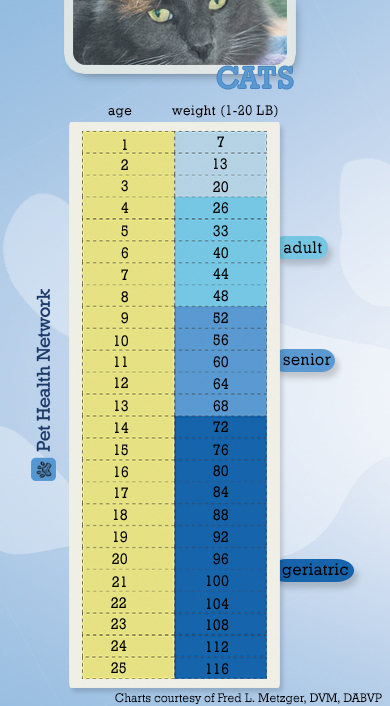
How Old Is Your Cat in People Years?


How old is your cat in people years?

The health of your pet can change drastically as he or she ages

Posted December 11, 2012 in Cat Health
cat age
Share This Story

28

694
836
Beginning at around age 9, your cat enters his or her senior years. At this stage, pets often begin to develop diseases common to their senior human counterparts, such as diabetes, heart disease, hyperthyroidism, and cancer. In fact, one out of 10 pets that appears healthy has an underlying disease.1  
First, identify your cat's real age using this chart. Then, discuss ways to keep your pet healthy with your veterinarian.

Reference:
1. Rehm M. Seeing double.Veterinary Economics. 2007;48(10):40-48.
- See more at: http://www.pethealthnetwork.com/cat-health/how-old-your-cat-people-years#sthash.L58qGBbW.dpuf

How old is your cat in people years?

The health of your pet can change drastically as he or she ages

Posted December 11, 2012 in Cat Health
cat age
Share This Story

28

694
836
Beginning at around age 9, your cat enters his or her senior years. At this stage, pets often begin to develop diseases common to their senior human counterparts, such as diabetes, heart disease, hyperthyroidism, and cancer. In fact, one out of 10 pets that appears healthy has an underlying disease.1  
First, identify your cat's real age using this chart. Then, discuss ways to keep your pet healthy with your veterinarian.

Reference:
1. Rehm M. Seeing double.Veterinary Economics. 2007;48(10):40-48.
- See more at: http://www.pethealthnetwork.com/cat-health/how-old-your-cat-people-years#sthash.L58qGBbW.dpuf

Monday, July 8, 2013

Dr. Sakas on the Radio.

Dr. Sakas will be a guest on the radio show "On Call" hosted by Wendy Wiese on Relevant Radio, Tuesday, July 9th from 1-2 PM CST. It can be heard on 950 AM, 930 AM, 1270 AM or accessed through your computer at www.relevantradio.com and listened to online. It is a call in show and Dr. Sakas will be a semi-regular guest on the show. Their phone number for call ins is 1-877-766-3777.

Future dates have been set up....all between 1-2 CST. Wednesday August 21st, Monday October 7th, and Tuesday November 26th. We will keep providing updates.

If you cannot listen to it live, it will be archived on the "On Call" portion of the Relevant Radio website at www.relevantradio.com.

Monday, July 1, 2013

West Nile virus outbreak in 2012 was the worst since 2003

With the warm weather, we now are seeing increases in the mosquito populations, with the resultant increased risk of exposure to mosquito-borne diseases. West Nile Virus is one of those diseases which poses a risk to people and certain types of animals.

When Summer Brings West Nile Virus

Reviewed by: 
Joseph V. Madia, MD By:

West Nile virus outbreak in 2012 was the worst since 2003

As summer begins, many may remember the West Nile outbreak that occurred in the summer of 2012. The CDC just released a review of that outbreak and how to avoid another.

The CDC report found that nearly all of the diseases carried by mosquitoes that were reported in 2012 were West Nile cases.

More than 5,600 cases were reported. This was the highest number of West Nile cases since 2003.

There is no vaccine for West Nile virus. The best methods of prevention are reducing mosquito populations and the likelihood of mosquito bites.

"Wear protective clothing to avoid mosquito bites."
 
The report, authored by a team led by Nicole P. Lindsey, MS, at the National Center for Emerging and Zoonotic Infectious Diseases at the Centers for Disease Control and Prevention (CDC), reviewed all the mosquito-carried diseases reported in the US in 2012.

Out of 5,780 mosquito-transmitted diseases (except dengue fever) reported in 2012, 98 percent of them were West Nile virus.

The 5,674 cases of West Nile reported were the highest numbers since 2003 in the US. They were reported in Washington, DC, Puerto Rico and every state except Alaska and Hawaii.

A total of 3,491 people with West Nile, or 62 percent of the total cases, were hospitalized, and 286 people (5 percent) died.

The patients who died were mostly elderly, between the ages of 68 and 84.

The majority of the cases occurred from July through September, when 92 percent of them were reported.
Most of these cases occur when a person is bit by a mosquito carrying the disease. West Nile can also be transmitted through blood transfusions or organ donations, but this is extremely rare.

Most people who become infected actually do not show any symptoms, but those who do usually have a fever.

About half of the cases (51 percent) reported in 2012 involved a neuroinvasive disease, which refers to a disease that affects a person's brain and/or nervous system.

That number of cases means about one person per 100,000 people with West Nile virus experienced this kind of complication.

Among the 2,873 people who had a neuroinvasive disease, a little over half (1,615 patients, or 56 percent) had encephalitis, or inflammation of the brain.

Just over a third (1,038 patients, or 36 percent) had meningitis, and 220 patients (8 percent) had acute flaccid paralysis. This refers to a severe weakness in people's limbs and organs, including difficulty breathing.
Most of the patients with acute flaccid paralysis also had encephalitis or meningitis.

The states that experienced the highest rates of cases were South Dakota, North Dakota, Mississippi, Louisiana and Texas.

In terms of the actual numbers of cases, those in Texas, California, Illinois and Louisiana accounted for over half of all the West Nile cases that resulted in neuroinvasive disease.

"Because human vaccines against domestic [viruses carried by mosquitoes] are not available, prevention of disease depends on community and household efforts to reduce [mosquito] populations," the team wrote in an accompanying editorial.

Chris Galloway, MD, a dailyRx expert who specializes in emergency medicine, agreed.
"It's bad enough getting stung by mosquitoes when you are trying to enjoy the outdoors," Dr. Galloway said. "It's worse when they can cause bad infections."

Dr. Galloway said the West Nile outbreak in 2012 teaches us once again that prevention is the key to avoid being infected.

"Avoid the outdoors during peak mosquito times and protect yourself and others with long garments and repellent spray," he said.

"The good news is that the majority that are infected do not develop symptoms," Dr. Galloway said. "Those that do develop symptoms should seek medical care, especially individuals over 60 and those with chronic medical conditions."

Prevention methods include using insecticides and reducing mosquito breeding sites by reducing the amount of stale or still water that's around.

Insect repellent and wearing protective clothing can reduce the likelihood of being bit by a mosquito.

The other mosquito-carried viruses reported in 2012 besides West Nile included Eastern equine encephalitis virus, Powassan virus, St. Louis encephalitis virus and California serogroup viruses such as La Crosse virus and Jamestown Canyon virus.

This report was published in the CDC Morbidity and Mortality Weekly Report on June 27. The report uses CDC funding, and the authors are CDC employees with no disclosures.

Thursday, June 27, 2013

Eliminating the Suffering of Chickens Bred for Meat

Eliminating the Suffering of Chickens Bred for Meat
One Green Planet www.onegreenplanet.org
Posted on February 22, 2013 by Karen Davis, PhD, President of United Poultry Concerns
“The question has been asked whether the suffering of industrially-raised chickens could be scientifically eliminated. What if scientists could create chickens and other farmed animals whose ‘adjustment’ to pathogenicity consisted in their inability to experience their own existence?” Please read this entire blog & circulate. Appreciative comments on One Green Planet directly following this article are welcome and – appreciated.
www.onegreenplanet.org/animalsandnature/eliminating-the-suffering-of-chickens-bred-for-meat-2/

Eliminating the Suffering of Chickens Bred for Meat By Karen Davis, PhD, President of United Poultry Concerns
"The misery of egg-laying birds has been well-documented, but what about the life of chickens bred for eating?" Andrew Purvis, "Pecking Order," The Guardian, Sept. 23, 2006.
Chickens are the largest number of land animals bred specifically for human consumption. Globally, more than 40 billion chickens are slaughtered each year for meat out of an estimated 65 billion animals killed annually for this purpose. Nine billion chickens die in the United States alone each year. Approximately 5 billion egg-laying hens are in battery cages throughout the world, many of them in production complexes holding a million or more birds.
Despite the disparity in numbers, battery-caged hens have received much more attention to their plight than chickens bred for meat have received. One reason, I believe, is that the suffering of egg-laying hens in battery cages is much more dramatically apparent to most people than the suffering of chickens in broiler sheds. Hens crammed together in battery cages allow an onlooker to distinguish a few hens out of thousands, and images of their suffering and frustration, their entanglement in wires and beating of their wings against cage bars, disturb even people who are unfamiliar with chickens. By contrast, chickens bred for meat are not raised in cages, although this could change by the end of the twenty-first century.
Chickens bred for meat are raised to six weeks old on floors in long low sheds the size of football fields, where they appear in their first week of life as thousands of indistinguishable yellow chicks, eating, drinking, and mixing with the sawdust and wood chips. In the weeks that follow, their weight multiplies many times over until, sitting heavily and inert in layers of excrement, lame and in pain, they appear to a person standing in the doorway of the stench-filled shed like lumps of dough stretching into the dark.
more chickens-l
Photo: David Harp
My own acquaintance with "broiler" chickens began in the mid-1980s when my husband and I rented a house on a piece of land that included a backyard chicken shed in Maryland. One day in June about a hundred young chickens appeared in the shed. A few weeks later the chickens were huge. I knew little about chickens at the time, but I was impressed by how crippled they were.
The chicken industry tells the public that thanks to research, better management, diet and other improvements, poultry diseases have been practically eliminated. However, industry publications and my own experience tell a totally different story. A big part of this story concerns what has been done to chickens genetically to create a heavy, fast-growing bird, falsely promoted to consumers as "healthy," even though poultry is considered the most common cause of foodborne illness in consumer households.
Chickens bred for meat have been rendered ill and unfit as a result of genetic manipulation, unwholesome diets, drugs, antibiotics, and the toxic air and bedding in the sheds where they live in almost complete darkness. Their bodies are abnormal. As I wrote in my book Prisoned Chickens, Poisoned Eggs: An Inside Look at the Modern Poultry Industry, "When you pick up a chicken on the road who has fallen off a truck on the way to slaughter, the huge white bird with the little peeping voice and baby blue eyes feels like liquid cement."
Even if you rescue a chicken from a poultry shed at one day old, the pathologies built into the bird will emerge in the form of cardiovascular disease, crippled joints, and an unnatural gait. The breast muscle grows large and pendulous, and excess fat squeezes the internal organs, impairing the bird's ability to breathe. Respiratory distress is innate in these birds. In the 1970s, a chicken farmer wrote, ironically, about the new type of chicken then being bred, that "the sign of a good meat flock is the number of birds dying from heart attacks." This remains true today.
The chicken industry tells the public that the "physical welfare" of chickens is very important to the industry, and that economic profitability cannot be achieved without careful attention to welfare. But that is not how the system actually works. Chickens bred for meat do not balloon out of all proportion in their infancy because they are content and well-cared for, but because they are artificially manipulated through genetics and management techniques to produce this outcome. In addition, they are slaughtered as babies, before diseases and death have decimated the flocks as they would otherwise do, even with all the drugs.
The question has been asked whether the suffering of industrially-raised chickens could be scientifically eliminated. What if scientists could create chickens and other farmed animals whose "adjustment" to pathogenicity consisted in their inability to experience their own existence? In the early 1990s, an engineer predicted that the future of chicken and egg production would come to resemble "industrial-scale versions of the heart-lung machines that brain-dead human beings need a court order to get unplugged from" (Robert Burruss, "The Future of Eggs," The Baltimore Sun, Dec. 29, 1993). As long as they don't "feel" anything, is it ethical to do this to chickens?
Agribusiness philosopher Paul Thompson has argued that if blind chickens "don't mind" being crowded together in confinement as much as do chickens who can see, it would "improve animal welfare" to breed blind chickens (Paul Thompson. "Welfare as an Ethical Issue: Are Blind Chickens the Answer?" in Bioethics Symposium, USDA, Jan. 23, 2007). A breeder of featherless chickens in Israel claims "welfare" benefits for naked chickens on factory farms, despite the fact that feathers help to protect the birds' delicate skin from injuries and infections, which is all the more necessary in an environment that is as thick with aerial pollution and ammoniated, fecal-soaked floors as industrial chicken sheds are. Philosopher Peter Singer, asked if he would consider it ethical to engineer a "brainless bird," grown strictly for meat, said he would consider it "an ethical improvement on the present system, because it would eliminate the suffering that these birds are feeling" (Oliver Broudy, "The Practical Ethicist," Salon, May 8, 2006.)
But would it eliminate the suffering these birds are enduring? What if the chicken's brain could be scientifically expunged? What if the elements of memory, instinct, sensation and emotion could be eliminated and a brainless chicken constructed? In the United Kingdom, an architecture student named Andre Ford has proposed what he calls the "Headless Chicken Solution" to the suffering of chickens on factory farms. (Olivia Solon, "Food project proposes Matrix-style vertical chicken farms." Wired, Feb. 15, 2012)
Drawing on Paul Thompson's "Blind Chicken Solution," Ford envisions the removal of the chicken's cerebral cortex. Removing the cerebral cortex, he says, would inhibit the bird's sensory perceptions so that chickens could be mass-produced without awareness of themselves or their situation in a technologized universe that would make it easier for the chicken industry to make even more money facilitating ever greater consumption of chicken products by a growing global human population.
Ford equates removing the chicken's brain with the "removal of suffering," but the suffering of chickens on factory farms is a matter of more complexity than science fiction and conventional "welfare" solutions can address. Chicken brain removal, far from removing suffering, takes suffering – the condition of injury or trauma whether consciously felt or not– to the ultimate limit of destroying the integrity of the bird as such. It accords with the agribusiness view of farmed animals as mere biological raw material to be manipulated at will.
Already, according to a poultry industry manual, "The technology built into buildings and equipment [is] embodied genetically into the chicken itself" (Bell and Weaver, Commercial Chicken Meat and Egg Production, 5th edition, 2002). Taking this "embodiment" to the ultimate extreme of total avian degradation is not the answer. If there is going to be humanely-produced chicken in the future, the burgeoning technology of "beyond meat," which replicates the texture and taste of chicken flesh using all-plant ingredients, will end the animal suffering, save the birds, be kinder to the planet and better for us. It will truly be something to crow about. (Brad Stone, "Venture Capital Sees Promise in Lab-Created Eco-Foods," Bloomberg BusinessWeek, Jan. 24, 2013.)
karen davis KAREN DAVIS, PhD is the President of United Poultry Concerns, a nonprofit organization that promotes the compassionate and respectful treatment of domestic fowl including a sanctuary for chickens in Virginia. She is the author of several books including Prisoned Chickens, Poisoned Eggs: An Inside Look at the Modern Poultry Industry (2009).
http://www.upc-online.org
Karen Davis, PhD, President
United Poultry Concerns
PO Box 150
Machipongo, VA 23405
Office: 757-678-7875
Email: Karen@upc-online.org

The dangers of leaving a pet in a parked car in hot weather, even with the windows partially open.

Here is a video demonstration of how hot it can get in a parked car for a pet (and people!) in hot weather, even with the windows cracked. Too many pets die and suffer because of being left in a hot car, because of owners not being aware of how dangerously hot it does get in these cars.

This is a very effective demonstration and will make you see how significantly elevated the temperature becomes and how deadly this situation is for any pet/person left inside these cars. It is imperative not to put them in this situation and please share this information with others so we can prevent any of these tragedies as during the summer heat (but it can also happen during hot days in other seasons as well).

This should open your eyes about dogs in a parked car, even with the windows open! http://www.ebaumsworld.com/video/watch/82689781#72uE57p8yLtQEDLZ.32